
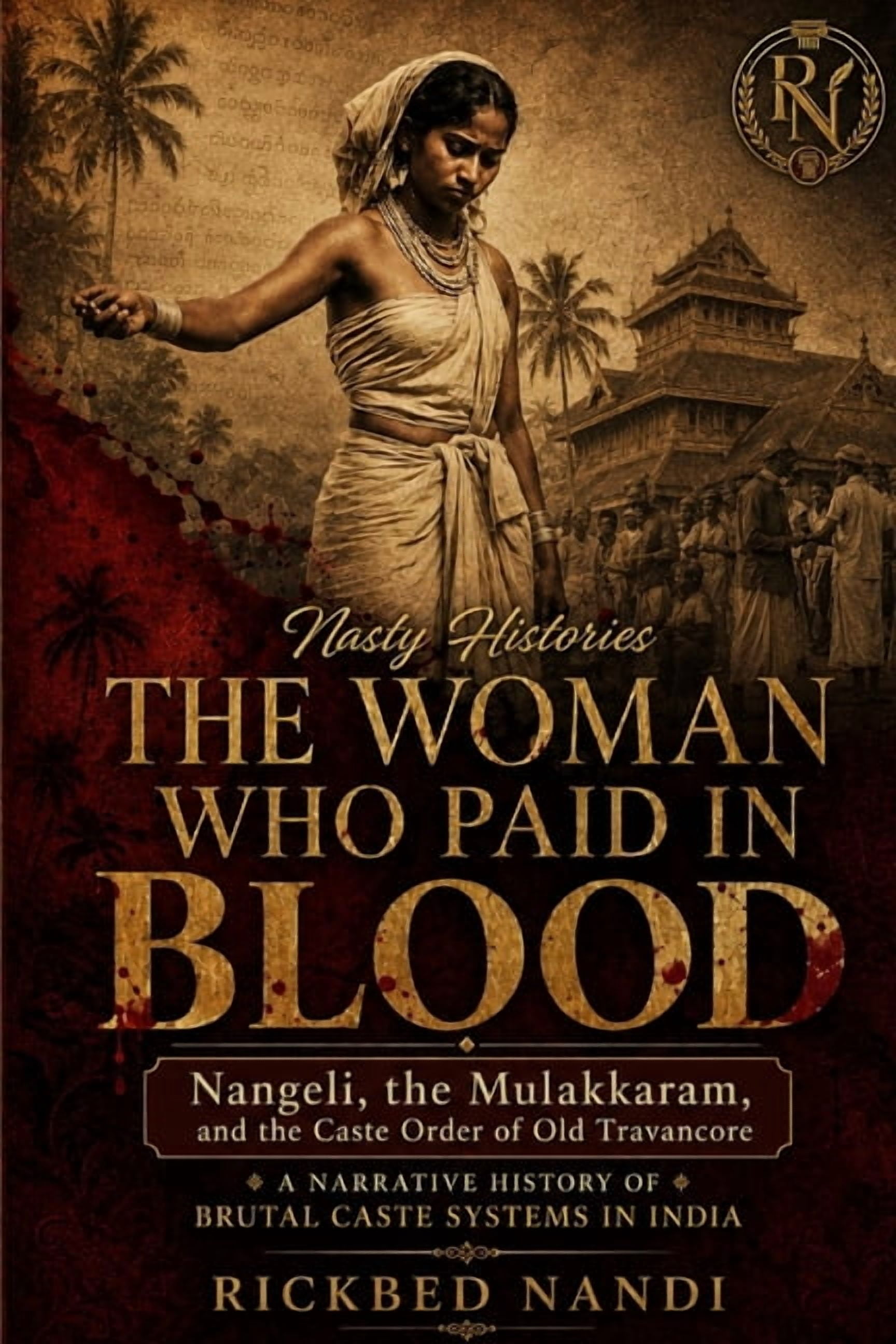
Nasty Histories The Woman Who Paid in Blood: Nangeli, the Mulakkaram, and the Caste Order of Old Travancore, (Paperback)
Product details
| Management number | 240054454 | Release Date | 2026/07/16 | List Price | US$5.81 | Model Number | 240054454 | ||
|---|---|---|---|---|---|---|---|---|---|
| Category | |||||||||
<b>PREFACE</b><br>This is a book about a woman who, in the small fishing village of Cherthala on the western coast of India, sometime around the year 1803, took up a sickle and cut off her own breasts. She placed them on a plantain leaf, in the same posture in which a tax collector would have expected to receive his measure of rice, and she bled to death. Her name, as her people remember her, was Nangeli. Her husband, finding her body when he came home, threw himself onto her funeral pyre.<br>I have been carrying this story around in my head for years. I first heard it the way many people now hear it - through a BBC report and a painting that travelled the internet - and I assumed, as you probably did, that the story was straightforward. A poor woman, a cruel tax, a brave refusal, a martyr. Caste villains. Royal abolition. Heroism. Closure.<br>But the longer I sat with it, the stranger it became. There are no court records of Nangeli. There is no missionary letter mentioning her. The Travancore State Manuals, which run to thousands of pages and include the price of salt and the diameter of irrigation wheels, do not name her. The Mathilakam Records, which the state kept locked inside the Padmanabhaswamy temple in Thiruvananthapuram, do not name her.<br>And yet. The plot of earth is real. The community memory is real. A woman in the rural underbelly of an early-nineteenth-century Hindu kingdom did not need to leave a written record to have existed. Her granddaughters did not need to be literate to remember her. The historian's silence is not the same thing as her absence.<br>So this book sits in the place where the legend and the archive disagree, and it tries to take both seriously. It tells you the story the way Cherthala tells it - slowly, in detail, with the smell of crushed plantain in it. It also tells you why the careful historians think the breast tax was something other than what the legend says it was. It tells you about the kingdom that produced both the tax and the legend - a kingdom whose rulers had legally dedicated themselves to a god, who reigned as Sri Padmanabha's slaves, who governed through a caste hierarchy that the Swami Vivekananda would later call a lunatic asylum. It tells you about the long chain of people, most of whom you have never heard of, who fought their way up out of that hierarchy - about the toddy-tapper's son who was imprisoned for grabbing a temple chariot, about the Pulaya farmhand who bought a bullock cart and drove it down a forbidden road, about the man who lifted a stone from a river pool and consecrated it as Shiva and started a religious revolution, about the women who burned the stone necklaces of their slave-status in a paddy field while the landlords' goons closed in.<br>It tells you about the boy king, twelve years old, who sat across the table from Mahatma Gandhi and was asked whether, when he came of age, he would let everybody into the temple. The boy said yes, certainly. Eleven years later he kept his promise.<br>I chose "<i>The Woman Who Paid in Blood</i>" not because I think it captures her or summarizes her but because it leaves room for both readings - the literal and the figurative, the historical and the folkloric. Blood was paid. By her, by women like her, by the whole structure of being-an-Ezhava or being-a-Pulaya or being-a-Channar in old Travancore. The blood is not in dispute. Only the woman is.<br>This book is for anyone who, like me, heard the legend and felt the small tug of disquiet that says: but is it true? And then felt a second tug, deeper, that said: and if it isn't quite true, does that make it any less hers?<br>C. For Nangeli, whoever she was.
- Nasty Histories The Woman Who Paid in Blood: Nangeli, the Mulakkaram, and the Caste Order of Old Travancore, (Paperback)
- Author: Rickbed Nandi
- ISBN: 9798185687338
- Format: Paperback
- Publication Date: 2026-07-05
- Page Count: 160
| Book format | Paperback |
|---|---|
| Fiction/nonfiction | Non-Fiction |
| Genre | History |
| Pages | 160 |
| Subgenre | Asia |
| Series title | Nasty Histories |
| Number in series | 0 |
| Edition | 1 |
| Publisher | Amazon Digital Services LLC - Kdp |
| Language | English |
| Is collectible | N |
| Recording time | 0 min |
| Retail packaging | Single Piece |
| Assembled product dimensions (l x w x h) | 6.00 x 0.40 x 9.00 in |
| Assembled product weight | 0.44 lb |
| Bisac subject heading | History |
Bestseller ranking
Women's History Books



Customers who viewed this product also viewed
Fly Reels






Correction of product information
If you notice any omissions or errors in the product information on this page, please use the correction request form below.
Correction Request Form